Friday, April 24, 2009

How Badly Pompeii was Affected by the Eruption of Mount Vesuvius

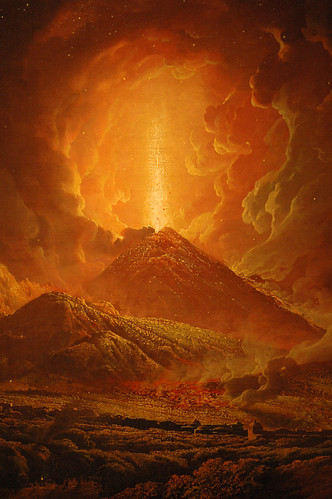
By the first century, Pompeii had many little cities and towns located near the base of Mount Vesuvius. This is where a substantial population grew, and had an affluent agricultural richness. However, it was on August 24, 79 that disaster struck. Mount Vesuvius literally blew its top, for the first time in 700 years, causing masses of molten ash, along with pumice and sulfur gas, suffocating both the inhabitants of Pompeii, along with people in adjacent cities. It also produced leaping flames coming off of several different points, whose bright glare was emphasized by the darkness of night. It was at this point that men, women, and children alike started to flee the city. "You could hear the shrieks of women, the wailing of infants, and the shouting of men; some were calling their parents, others their children or their wives, trying to recognize them by their voices."(Berry, 22) Many knew that a gruesome fate that was ahead for their relatives, which was death. Many prayed for the aid of the gods, however many thought they no longer existed.

Vesuvius had entered a history of volcanology with an eruption in 79AD.This explosion of the famous volcano had destroyed Herculaneum, Oplonti, along with the major city of Pompeii. Before its major eruptions, several earthquakes occurred, but were disregarded by the local community as just another phenomenon. "Wells dried up and springs stopped flowing. Dogs howled and birds were strangely silent. But Pompeiians went about their daily business, oblivious to the rumblings under their feet or the strange behavior of their pets."(Roberts, 16) However, Vesuvius’ major destroying eruption would not go unnoticed.

Residents quickly gathered as many personal belongings as possible out of their homes, and evacuated quickly to escape the choking ash. Much of the residue from the hurling debris gathered on rooftops, causing them to collapse. Slaves guided their masters through the streets on chairs, while livestock and carts were crowded all along the walkways. By dusk, ninety percent of the population had reached safety, and more would have most likely been out of harm if they were aware of what the mountain had in store. Instead they chose to ignore all of the warning signs including many earthquakes that shook the land beforehand.

The city was left in a state of devastation. An estimated 20,000 people died within the six surges of the eruption. The inhabitants who did not flee or die during the eruptions, were the first to be turned to an alternate technique of climbing trees in desperation in order to escape the dense pumice and debris that crowded the streets. However, many still died; the two primary causes being suffocation from the fumes, and broken bodies from the force of the eruption. Although most people were able to escape from the town, many still perished within the city of Pompeii and the nearby countrysides. It would not be until many years later through different avenues of excavation and rebuilding would frightening signs of death be present, such as extremely precise figures and outlines of the destined Pompeianites who were unsuccessful in their attempt to escape. Reisn and plaster would be used to capture the victims in their last seconds of life with supernatural expressions on their faces with detailed, disinct life like characteristics.

The city of Pompeii had not only endured severe damages to the land itself, but also the population. About 1,150 bodies were found through a recovering process within the ash deposits. The city of Pompeii was not rebuilt at that time, as the townspeople did not want to undertake the very extensive work that would need to take place in order to revitalize it. Much of the village and towns have been forgotten, as they are buried under several feet of ash due to the lava flow. Additionally, weathering erosion, and light exposure have all damaged the city over the years. The lack of air and moisture have allowed for the objects to remain underground, which makes the site good for analysis to understand more of this disaster. This remarkable tragedy, though terrible, has been in a state of conservation, providing its legacy to live on.

Even though the city of Pompeii was completely buried, it was revived to a degree again beginning in 1748 after more than 1600 years since its destruction at the hands of volcanic activity. Although many of the people were found buried under twelve layer of soil, astonishingly enough, many of the buildings were well preserved as well as the bodies which were frozen in time often dipicted in those just going about their daily routine of life that fateful day the volcano erupted. The ruins at Pompeii have imparted archaeologists much indispensible information with regards to how the people in the Roman Empire lived. The city of Pompeii is a fashionable travel destination today and one of the most visited cities with a prosperous income produced from curious travelers eager to get a glimpse of pop culture and history.


Berry, Joanne. The Complete Pompeii. London: Thames and Hudson Publishers, 2007.


Roberts, Russell. Mt. Vesuvius and the Destruction of Pompei, AD 79. United States: Mitchell Lane Publishers, 2005.



Friday, April 17, 2009

Stoic Movement in Ancient Rome

The single most important philosophy in Rome was Stoicism, which had its start in Hellenistic Greece. The substance within the worldview was very applicable to Roman religion, particularly because its insistence on agreeing that all situations were acceptable. This created a mindset for the people of being able to achieve their own level of virtue. However, the core of Stoicism was the concept of logic, and achieving virtue and worth through naturalistic beliefs. To them, this is what gave meaning to the universe.


Stoicism was the philosophy of both the Greek and Roman philosophers. These people were known as "Stoics" because of the school's founders, who were Zeno and Cyprus. These leaders taught at the Stoa Poikile(the painted porch) which is how the name came about. Their primary focus was on having a thriving relationship between cosmic determinism and human freedom, which included having a virtuous relationship and living in harmony with nature. "An effect of this portrayed their beliefs as a way of living, and thought that the best sign of an individuals outlook was not by words, but actions. "(Strange, 23) In was in Rome’s Ancient history that people such as Seneca and Epictetus accentuated that "virtue is sufficient for happiness"; a main theme within this movement.


The basic tenets of this movement were that it provided a correct outlook on the world through naturalistic ethics and formal logic. Logic to the Stoics referred to the meaning of an individual through the extent of sentences. "They used this method and stated that a sentence has no meaning unless it is completed, which implied that everything that happened on a daily basis was part of a bigger meaning, in painting the picture of history."(Sellars, 45) It was a component to greater good or reason. A quote that explains the connection between logic and using words to express it states, "Make yourself a definition or description of the thing which is presented to you, so as to see distinctly what kind of a thing it is in the substance, in its complete entirety, and tell yourself its proper name, and the names of the things of which it has been compounded, and into which it will be resolved. For nothing is to productive of elevation of mind as to be able to examine methodically and truly object to what is presented to you in life." This statement is essentially saying that we as human beings can create our own reality to live by, according to our own logic, paving our on way, relying only on ourselves.


They also emphasized ethics in a way that based itself off of human knowledge, and in addition was an agent for teaching of self control and morals. By gaining understanding through this, it taught people how to be good thinkers, and to comprehend universal reasoning, making improvements on them as a person. Another saying that goes along with this is "Virtue consists in a will which is in agreement with nature." In order to have virtue and live correctly, you must adjust your life according to natural law.


The idea of Stoicism is very contrary to our currant system in our world today. It is evident that Stoics concentrated on the values of simplicity and equality amongst their people. In our modern culture, we do not view all people the same and are very critical and quick to judge within society. We also do not use common logic often, which would be looked down upon from their culture.


Another component of the Stoic structure was their ethics, which are seen very rarely today. Contrary to ethics being the only way to both achieve and understand true good, we have almost completely discarded ethics, which has the effect of corrupt souls. There are no sufficient means for happiness anymore, as our culture is extremely secular. A corresponding idea recited by a Stoic says that "the person who has achieved perfect consistency in the operation of his rational faculties, the "wise man", is extremely rare yet serves as a prescriptive for all." This sufficiently explains our culture today in comparison with Stoicism- we have fallen from conducting our lives with logic and morals, making prudent individuals hard to come by.

As stated above, it is very clear that the Stoic movement had its primary values that composed their belief system. It was through logic and naturalistic concepts that Stoics formed their worldview and outlook on life. Contrary to the modern Society, we do not take the time to think through situations with the precise logic this movement presents, but rather settle for mediocrity, not caring if we understand the world around us fully. Despite these differences, and the poor outlook the Stoics might have on our society, both are their own views on the world that can easily be contrasted, which is a key factor in understanding both histories.

Sellars, John. Stoicism: University of California Press: 2006.

Strange, Steven K. Stoicism: Traditions and Transformations: Cambridge University Press: 2004.

Friday, April 10, 2009

Early Christian Movement: Impacted by the Roman Empire

The underpinnings of Christianity as it relates to the Roman Empire is one that benefited from great widespread expansion throughout the height of the empire as never seen before. With Rome under stable control around the time of 27 BC, the society had entered an age of prosperity, expansion, and political stability. It was during this same period that Christianity began to develop. This growth was made possible through the inner orderliness of the church, which caused it to spread and eventually become institutionalized.

The very beginning of Christianity's official growth occrued with the church. "Since the very start of the religion, Christianity was scattered throughout the Roman Empire , however keeping Christianity unified was a major concern of the church leaders."(Novak, 32) It was the structure and arrangment of the Roman Empire that influenced how Christianity first came about. It also affected how it spread throughout other regions, which started out in urban cities, which were mainly populated by slaves and the poor, eventually spreading throughout Rome and a vast majority of the citizens.

One of the most important factors in the growth of Christianity by the Roman Empire was when Constantine was emperor. He saw the religion as a potential coalesce for society, and began to rapidly expand it. He began this by constructing several churches throughout Rome, and also passed decrees allowig many religions to be tolerated, but making clear that the people of Rome would benefit from Christianity the most. Many people were initially skeptical at this idea, since Christianity had taken nearly three centuries to fully develope, but he still adhered to the hope that it would gain imperial support as the others religions of that time had. He also appointed many bishops in order to help him with his movement and thus, Constatine's reign not only made early Chirstianity popular, but also equipped it with prestige in order for it to flourish.

Additionally, another person who would prove to have a significant impact on the growth of Christianity during Rome's history was Theodosius I. Although he was not a very well-known emperor, there is no doubt that he had a major role in expanding Christianity. As Michael Grant put it, "He earned the title Great becasue of his devout Christianity." "The main reason for this was that he used his power to actively enforce the religion, which ended up placing the power under the church, which set a standard for more than a millenium."(Addis, 42) Theodosius first displayed that he was a supporter of early Chirstianity and relied on God's help when he was witnesses in distress during a riot, and was observed publicly pleaded for God's mercy. It was clearly perceived that these actions marked a new chapter in Rome's history- one that would be marked in history as unifying church and state.

Yet another Roman emperor who devoted a majority of his reign in spreading Christianity was Jovian. At this point, both the Roman and Christian Empires celebrated at the arrival of another Christian as the leader of the state and his attention was primarily on impacting the Roman empire by turning all paegan temples in the area to churches. Another major step taken, was reestablishing Christianity as the official religion of Rome and continuing even farther, it was during his reign that Christianity remained the primary religion in both the Western and Eastern Roman Empires.

At the heart of Christianity's rise to prominence within the Roman Empire, credit can be given to many of the emperors named above. In addition, a result of this, many people converted to Christianity as a result of both because of the early church and the Christian emperors who devoted their power and prominence to help it continue in its strength. The ultimate attempt at seperating church and state was no longer possible during this time, as this religion was both the official and dominant belief throughout Rome. Despite its slow progression, early Christianity, under the Roman influence, came to domination.

Novak, Ralph. Christianity and the Roman Empire: Continuum International Publishing Group: 2001.

Addis, William. Christianity and the Roman Empire: Sunday School Association: 2006.

Saturday, March 7, 2009

Roman and Greek Pantheons

The Greek and Roman pantheons are a minor indication of one another. When looking at the gods of these two social groups, there is a clear portrayal of cultural rules, as well as vital customs with important implications. The main gods contained within these societies had a substantial effect on the Western culture as a whole, and more importantly how they were thought of and related to in the minds of people inside both the Greek and Roman worlds.


The source of the Roman pantheon and the groundwork for their mythology began with the faceless gods that contributed to the support to the community, while at the same time dwelling in all living things. The early Romans were not very concerned with the specific characters of the gods, but were more focused on whaThe source of the Roman pantheon and the groundwork for their mythology began with the faceless gods that contributed to the support of the community, while at the same time dwelling in all living things. The early Romans were not very concerned with the specific characters of the gods, but were more focused on what each of them were responsible for.“God’s presided over every aspect of life and death, including the phases of the agricultural year and the Romans also integrated their worship to these gods into both their public and private life.”(Bierlein 24) These gods and goddesses also came about from numerous religious influences, many of which had their start in Greek and Etruscan tribes. The various names given from the roots of these cultures lasted many years throughout Rome, and were eventually adopted to the extent that they upheld their names from other societies each of them were responsible for. It was through the syncretization of numerous Greek gods that established the Roman pantheon.
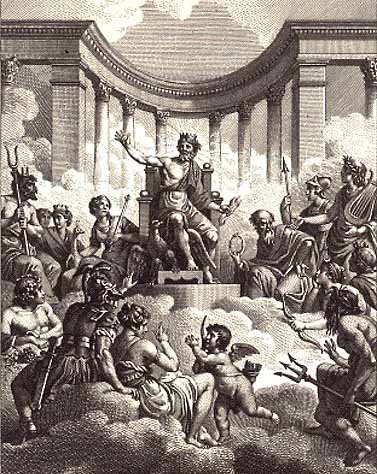
The Roman pantheon really began to emerge when they established their main gods, along with their key roles. Some of the gods which include but are not limited to were known as Jupiter the ruler of the gods, Apollo god of prophecy and the sun, Mars god of war, Minerva goddess of wisdom, Saturn god of agriculture, Venus goddess of gardens and fields, Pluto god of the underworld, and Neptune who was the god of the sea and earthquakes. The Romans envisioned their gods as more of powers than as people and they also thought that all their religious practices were preserved under the “pax deorum” or “peace of the gods”, which guaranteed the publics’ prosperity wealth and well- being.


In comparison to the Roman pantheon, the Greeks also had their primary gods. These gods are most commonly mentioned in their mythology, which were stories that explained the origins of the world, as well as details and adventures of the gods. In contrast to the Roman gods, the Greeks focused more on their unique personalities and genealogy with an example of this being that gods were associated with the various aspects of life. This was also a similar characteristic of the Roman pantheon, and likewise, the Greek gods also had a major influence over the culture and many other areas of life. Several people from these ancient times derived influence from Greek mythology and have discovered its contemporary significance.


In contrast with the Romans, the Greeks also instituted their major gods and goddesses, most commonly referred to as the twelve Olympians. These consisted of: Zeus the supreme ruler of all gods, Poseidon the god of the sea, Hades the god of the underworld, Hera queen of the gods and goddess of marriage and fertility, Demter the god of the harvest, Hermes the messenger god, Athena the goddess of war and wisdom, Dionysus the god of wine, Aphrodite the goddess of beauty, Hephaestus the god crafts, Ares the god of war, Apollo the god of music and prophecy, and Artemis who was the god of the hunt. These twelve gods and goddesses were also common in the Roman pantheon with the primary difference being a change in names, however, despite this, the Romans too had gods who attained these roles.
As detailed above, it is clear that both the Roman and Greek pantheons were so important that they were at the center of everyday life. They regarded it as part of their history, and used them to describe natural phenomena, variations in culture, and traditions in their culture. "For long periods of time the ideas of numerous gods and goddesses took on the prestige of elite knowledge that had a significant mark on history."(Laing, 60) Both of the pantheons had a role in each other, and had a constant, overlapping relationship that helped with their establishment.


Bierlein, J.F.: Myths: Random House Publishing Group: United States: 1994.


Laing, Jennifer: The Greek and Roman Gods: David and Charles Publishers: United States: 1982.


Friday, February 27, 2009

Ancient Roman Art

The year 510 B.C.E. is usually the year cited as the beginning of the Roman era, for it was then that the Roman Republic was founded. This period included a long era of expansion and consolidation in which many territories were brought under Roman rule and with this rule came the ushering in of great works of art. Roman art world evolve to include not only the visual arts that were produced in Rome, but major art forms known as mosaics, architecture, sculpture, and painting. All of these unique styles have their own contribution to Rome through their communication and portrayal of the different aspects of the Roman culture.

The first kind of very popular artwork done by the Romans was the mosaic. These intricate pieces of art were assembled by placing small portions of glass, tile, or stone into a mortar background, that shaped a pattern or picture. The Romans derived this skill from the Greek tradition and established this form of art in the third or fourth century. The mosaics were most commonly used as floors, and illustrated both Greek and Roman heroes within literature, gods, daily life, and impressions of nature. The level of detail in making these was extremely incredible; the great benefit of them being that obtained substantial durability and lasting color. Their durable construction and lasting quality gave way to explaining why floor mosaics remained intact for such long periods of time.

A second type of artwork that was done by the Romans was architecture. It was in this area that Rome produced its greatest innovations. Because the Roman Empire extended over a vastly large region, Roman engineers developed methods of building on a very impressive level. Some of the most renown structures built include the Colosseum and the Pantheon, which required vast progress within the engineering field on a substantial scale.It was during Rome’s Golden Age that the massive building programs of monuments, aqueducts, baths, palaces, and temples emerged. The common Greek and Etruscan influences were also present in these developments as well. This was key in producing novelties such as the round temple and curved arch, both of which were very common and widespread
The third variety of Ancient Roman art was sculpture. It was at its peak of popularity in about 146 B.C. and most were inspired by the Greeks. Statues were most commonly used in decorating houses or villas, and were also used to honor a ruler, commemorate victories, or to promote the government. They were carved in such a way to produce the most realistic views of these things. This was prominent with the public, as for it being a society without any newspapers or photographs, it was the grand sculptures that was a significant source of both information and communication.


A fourth method of art was painting. Romans painted primarily on panels or plaster, as well as the walls, ivory, and wood. Panting were usually done of gardens, woods, groves, trees, channels, coastlines, and rivers. “ This was sometimes done by covering the whole area of the walls with elaborate landscapes, in which depth, atmosphere, and light are rendered in a highly pictorial, illusionist manner.”(Hodge 14)This popular painting technique was known as “fresco” and included brightly colored backgrounds that were separated on walls in different rectangular sections. Not only was painting primarily focused on depiction, but also provides and illustrates a brief history of Rome.
Roman art is vast and wide and has generally been viewed as beginning with the republic in 510 BC with the end of Roman art and the beginning of medieval art occurring with the transition to the emperor Constantine to Christianity. Roman styles which include pagan roman subjects continued for centuries that followed however usually appearing as Christian art because of the influence of Christianity. "Roman art had been historically divided into two main phases the first being the art of the Republic and the second as the art of the Roman Empire with variations emerging depending upon which dynasty was ruling at the time."(D'Ambra, 46)With the initial Republic founding the expression Roman Art was tantamount with the city of Rome and it was only within the last two centuries that Greece and Roman art divided from Etruscan art and before Christ there is seen a unique Roman manner of building, sculpting and painting as described above. Owed to the diverse and expansive geography of the Romans Empire along with the many varied populace, the resultant art to come out of Rome has always been dissimilar with m any variations owing to the distinctive areas individual taste and inclination towards art at the time.


Hodge, Susie Ancient Roman Art: Heinemann Interactive Library: United States, 1998.


D'Ambra, Eve Roman Art: Cambridge University Press: Unites States, 1998.


Tuesday, December 9, 2008

Final Exam Questions

1.) What effect did geography have on the civilations that emerged in Egypt and Mesopotamia?
2.) What were some features that both the Persian and Assyrian Empires had in common?
3.) In the city-states of Ancient Mesopotamia, the economy was based on: ( ) plus ( ) and industry.
4.)Who divided the Persian Empire into satrapies, or pronvinces?
5.)Where was the site of Minoan civilization?
6.)What three factors made it possible for the emergence of civilization in Mesopotamia?
a.monotheism, cuneiforms, defensive lines
b.cities, organized governments, irrigation
c.monotheism, arranged marriages, building supplies
d.pyramids, slavery, astronomy
7.)The ( ) style of temple architecture featured slender columns with spiral-shaped capitals
a. Hellenistic
b.Doric
c.Corinthian
d.Ionic
8.)The ( ) weakened the major Greek states and destroyed any possibilty of cooperation among them:
a.Long Walls
b.The Great Peloponesian War
c.Battle of Marathon
d.Persian Wars
9.)The Athenians formed the ( ) to serve as a defensive alliance.
10.)Sparta's ( ) decided which issues to confront their assembly with.

Tuesday, November 25, 2008

Greek Architecture


Greek Architecture would have far reaching and lasting effects and many actions to come since its inception. If you look around at architecture seen through banks, office buildings, churches, and museums, you are almost sure to see some aspect the derived from the Greek form of architecture many years ago. It has been copied, emulated, and admired for many centuries and is still viewed as a classical form of architecture ad design as well as great aesthetic beauty in many forms.


There were three main styles or “orders” in Greek Architecture, which consisted of Ionic, Doric, and Corinthian. These three main designs were most commonly portrayed through the construction of Greek marble columns, which were by far the most prominent structure in their architecture. Their names were used by the Greeks and also reflected their beliefs pertaining to these styles, which descended from the Ionian and Dorian Greeks from the Dark Ages. These styles were so important that it not only made Greek art original, but played a significant role in changing art for those who preceded them. The Ionic style originally evolved in Ionia on the eastern shore of the Aegean Sea. This type of column was very elegant and had a scroll- like design, also known as a volute. Ionic columns normally stand on a base which separates the shaft of the column from the styobate, or platform. The capital of the Ionic column has characteristic paired scrolling volutes that are laid on the molded cap that springs from within it. The cap being the most elaborate detail, was usually very enriched, and just as the vital volutes lied in a single plane that was angled at the corners. This brought both uniqueness and originality to the detailed Ionic columns, which were to be admired and emulated throughout time.


The Doric “order” was the earliest style developed of the prominent three. It originated in the 7th and 8th centuries, reaching its apex in the 5th century. Because of its appearance, these columns were most commonly built on the outside of churches and public meeting places. In their original Greek version, Doric columns stood directly on flat pavement of a temple. Its exterior can be described as having parallel grooves that run from the top to the bottom of the columns. They were topped with a square- cut piece of marble that intersected with the vertical grooves.


The Corinthian column, the most elaborate of the three columns, was the most seldom used in Greek Architecture. This type of column has a ring- like molding, or banding beneath it at its base. Preceding its vertical indentions that characterize the Greek columns, it has elaborate designs at the top. Some of which included bellflowers and leaves that were decoratively carved. These detailed columns can also be seen in many prominent buildings such as the Flavian Amphitheatre and the Coliseum.


If some of these elements look familiar, it is because they have been passes in to the vocabulary of Western Architecture and form part of the basis of the style referred to broadly and known as classical. For centuries banks, museums, universities, government buildings, and churched have been built using the elements and style first designed and named by the Greeks.(Getlein 314)


The Greeks not only designed and executed the art of building beautiful columns, but also created them in such a way that has had a profound effect throughout the ages. Many of the styles have been reproduced and copied by some of what the modern day audiences would class as some of the finest architecture. Greek architecture was of great importance because the immense majority tell the timeless stories of gods, heroes, events, and the Greek culture in general. Many people even in today’s modern times copy the revered style as a sign of respect. They have depicted the famous architecture that truly changed the way art was viewed by the nations that followed.


The significance of Greek architecture as it relates to the history of Western civilization is of great importance and lasting substance. The Greeks were responsible and are to be credited with some of the most continuing themes, styles, viewpoints, and approaches to architecture that have engrained themselves throughout Western civilization.